


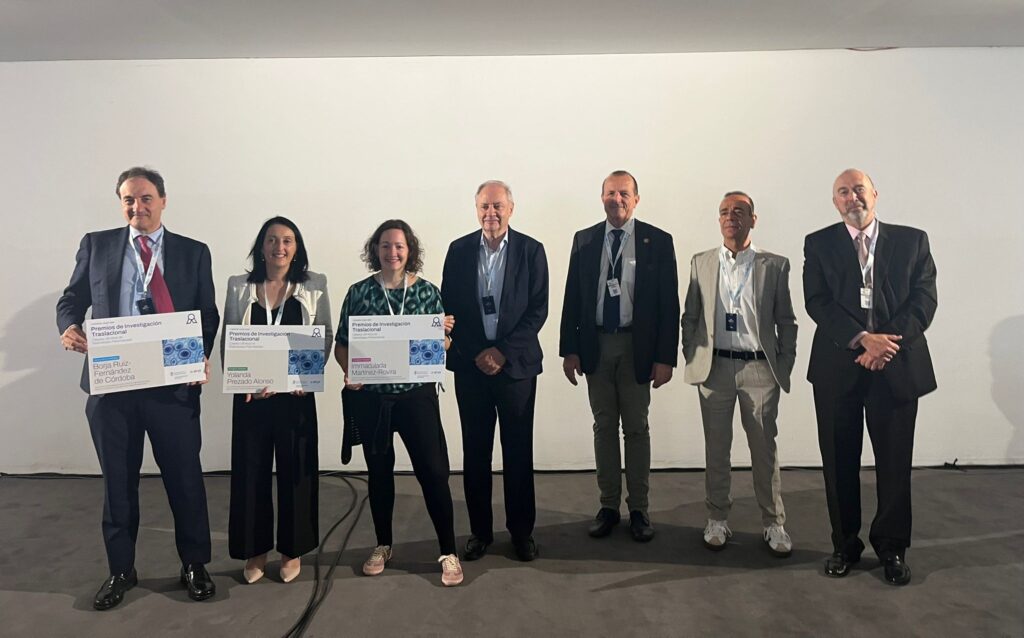
- The awards, presented at the SEOR 2026 Congress in Alicante, recognise pioneering research with the potential to transform cancer treatment
- The award-winning research explores new approaches to radiotherapy for tumours resistant to conventional radiation, new strategies for the treatment of triple-negative breast cancer, and the biomolecular impact of advanced therapies on osteosarcoma
- With these accolades, the UB-Atrys Chair reinforces its commitment to research, knowledge transfer and progress towards a more precise, innovative and personalised approach to oncology
The UB-Atrys Chair in Personalised Radiotherapy, established by Atrys Health and the University of Barcelona, has recognised the three most outstanding scientific publications in the field of radiation oncology in 2025, honouring their excellence, innovative capacity and potential clinical impact.
The fifth edition of the awards ceremony took place as part of the SEOR 2026 Congress (Spanish Society of Radiation Oncology), held in Alicante, one of the sector’s leading scientific gatherings, which this year brought together national and international experts under the slogan “Precision oncology at the service of the patient”.
The opening session featured a presentation by Phillip Poortmans, an international authority in radiation oncology affiliated with Iridium Netwerk and the University of Antwerp, who outlined the latest advances in FLASH therapy, one of the most promising technologies in the field. This was followed by the awards ceremony, moderated by Dr Ferran Guedea, director of the Chair and head of Radiation Oncology at the Catalan Institute of Oncology, alongside Dr Marco Panichi, medical director of Radiation Oncology at the Atrys-Sanitas Institute of Advanced Oncology and co-director of the Chair. Also present at the event was Santiago de Torres, non-executive chairman of Atrys, who was responsible for presenting the awards
Three research projects that point the way to the future of radiotherapy
The first prize was awarded to Yolanda Prezado Alonso, an Oportunius research professor at the University of Santiago de Compostela, for her research into mini-GRID radiotherapy, a novel technique involving spatially fractionated irradiation using very small beams in linear accelerators without a flattening filter, which allows high doses to be delivered heterogeneously and with precision, reducing damage to healthy tissue and opening up new possibilities in the treatment of complex tumours.
The second prize was awarded to Borja Ruiz-Fernández de Córdoba, a researcher at the University of Navarra, for his work on innovative strategies to improve the response to radiotherapy in triple-negative breast cancer, one of the most aggressive subtypes with the fewest treatment options.
The third prize was awarded to Immaculada Martínez-Rovira, a researcher at the Autonomous University of Barcelona, for her study on the biomolecular impact of carbon-ion beam radiotherapy in osteosarcoma, research that contributes to a better understanding of the mechanisms of action of high-precision therapies.
Research driving precision medicine
In this regard, Dr Guedea emphasised that “The mission of the UB-Atrys Chair is to promote increasingly personalised radiotherapy, linking cutting-edge research with real-world clinical practice. These awards reflect our commitment to identifying and supporting the scientific talent set to transform oncology, so that advances reach patients sooner and more effectively”.
For his part, Dr Marco Panichi emphasised Atrys’ commitment to developing innovative solutions in radiotherapy: “Radiotherapy is undergoing an unprecedented transformation, driven by technological innovation and biological knowledge. At Atrys, we are committed to connecting research, technology and clinical practice to accelerate the delivery of these solutions to patients.”
The first-prize winner, Yolanda Prezado Alonso, highlighted the value of this recognition: “This award highlights lines of research that seek to bring about real change in the way we treat cancer. Mini-GRID radiotherapy has the potential to significantly improve therapeutic efficacy in resistant tumours, and recognition such as this is key to continuing to make progress and translating these results into clinical practice.”
With this fifth edition, the UB-Atrys Chair consolidates its role as a driving force behind research, training and knowledge transfer in radiation oncology.
The award-winning projects demonstrate how the combination of technological innovation, cancer biology and multidisciplinary collaboration is redefining the future of radiotherapy, bringing us closer to increasingly personalised, precise and effective medicine